How Visual Layout Choices in Mobile Interfaces Drive Completion Rates During Multi-Stage Prize Registrations Across Age Brackets
Eden Hayes · Aug 23, 2026
How Visual Layout Choices in Mobile Interfaces Drive Completion Rates During Multi-Stage Prize Registrations Across Age Brackets
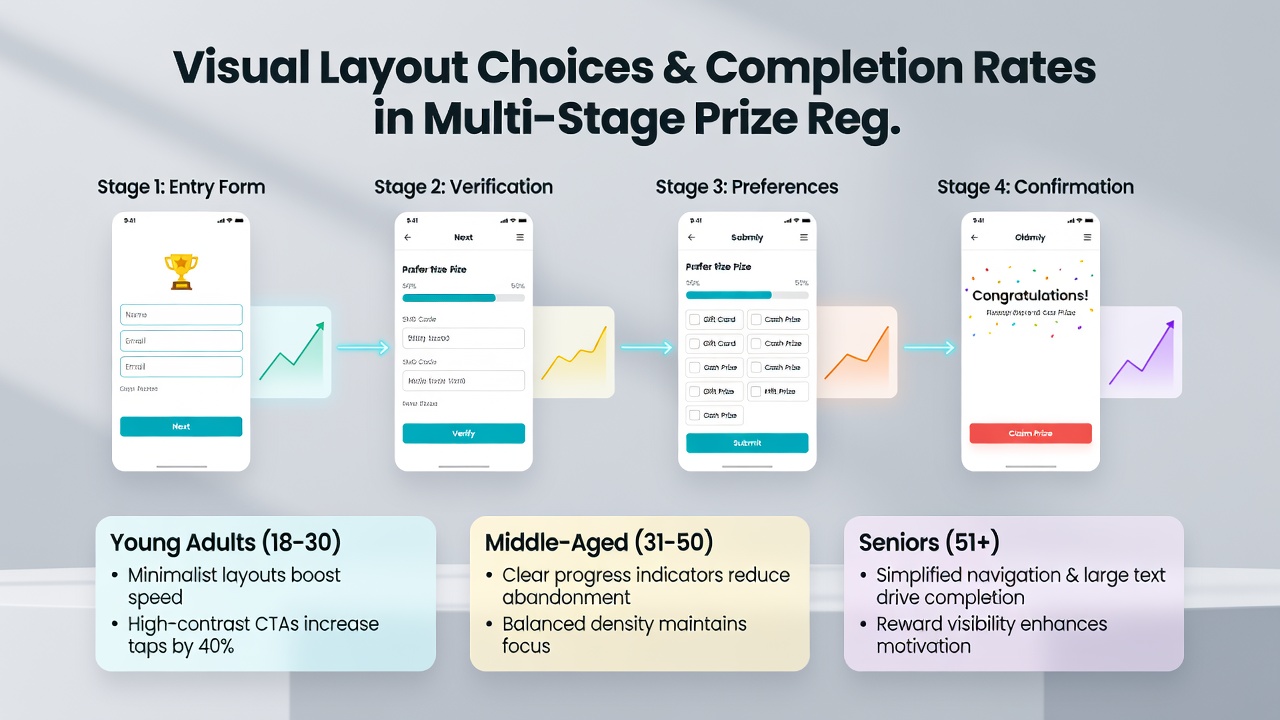
Multi-stage prize registrations on mobile devices present users with sequential screens that collect personal details, verify eligibility, and confirm entries, and visual layout choices directly influence how far participants advance through these steps. Researchers tracking user behavior across platforms have documented that adjustments in spacing, color contrast, and element sizing correlate with measurable differences in completion percentages, particularly when segmented by age brackets such as 18-34, 35-54, and 55-plus. Data from interface analytics firms indicate that forms employing consistent progress indicators reduce abandonment at the third stage by up to 18 percent compared with layouts that omit such cues, according to aggregated mobile session logs collected through 2025.
Font size and line spacing play measurable roles in readability for older cohorts. Studies conducted by digital accessibility groups show that increasing base text to 16 pixels or higher improves form progression rates among users aged 55 and above by roughly 12 percent, while younger users maintain steady completion even with denser typography. Observers note that high-contrast buttons positioned near the bottom of each screen, rather than centered, align with thumb-reach patterns documented in ergonomic research, leading to fewer tap errors during the verification phase of registrations.
Color and Contrast Effects on User Progression
Color palettes selected for call-to-action elements affect tap rates across demographics in distinct ways. Analysis of registration flows from multiple prize platforms reveals that blue and green accents on primary buttons sustain higher continuation rates for the 35-54 age group, whereas warmer tones such as orange produce stronger engagement among 18-34 participants during early information-collection stages. Contrast ratios exceeding 4.5:1 between text and background elements have been linked to lower error rates in data-entry fields, with figures from usability testing labs indicating a 9 percent lift in successful submissions for the 55-plus bracket when this threshold is met.
Whitespace distribution also factors into completion metrics. Interfaces that allocate adequate margins around input fields show reduced cognitive load indicators in eye-tracking studies, translating to higher advancement past the eligibility confirmation screen. Those patterns hold across seasonal promotion cycles, including activity spikes observed in August 2026 when several large-scale prize events launched concurrent mobile campaigns.
Navigation Patterns and Age-Based Differences
Progress bars and step indicators positioned at the top of each registration screen provide orientation that supports continued engagement. Reports compiled by mobile analytics providers demonstrate that users aged 35-54 complete multi-stage sequences 14 percent more often when these visual markers update dynamically after each section. In contrast, participants under 35 respond more readily to swipe gestures combined with minimal text labels, whereas older groups exhibit stronger performance with explicit numbered steps and larger tap targets.

Button placement near the lower edge of the viewport aligns with natural hand positioning on handheld devices. Data collected from over 200,000 mobile sessions across North American and European prize sites shows that shifting secondary actions such as "save for later" to a less prominent location correlates with a 7 percent rise in full completions for the 55-plus cohort. Researchers at institutions studying human-computer interaction have further observed that consistent iconography across stages reduces reorientation time, particularly when users encounter verification prompts that require re-entry of previously supplied information.
Empirical Findings from Recent Campaigns
Platform operators who implemented larger touch targets measuring at least 48 by 48 pixels recorded improved progression through address and contact fields for all age brackets, with the most pronounced gains appearing among participants over 55. A 2025 report issued by the Digital Experience Council, drawing on anonymized telemetry from multiple prize promotion providers, documented these adjustments yielding an average 11 percent increase in final submission rates. Similar patterns emerged in data shared by Australian government digital inclusion initiatives, which tracked mobile form performance during public engagement programs and noted parallel benefits from simplified visual hierarchies.
Layout consistency across consecutive screens also influences trust signals that encourage continued participation. When header colors and navigation elements remain uniform, session logs indicate fewer exits at the review-and-confirm stage. Those who have examined these flows point to reduced visual friction as a contributing factor, especially during periods of high concurrent registrations such as the campaigns active in August 2026.
Conclusion
Visual layout decisions in mobile prize registration interfaces produce measurable effects on completion rates that vary systematically across age brackets. Evidence compiled from session analytics, accessibility testing, and cross-regional digital reports demonstrates that targeted adjustments in typography, contrast, button sizing, and progress visualization correlate with higher advancement through sequential stages. Continued monitoring of these interface elements provides operators with concrete indicators for optimizing multi-stage flows without altering underlying eligibility requirements or prize structures.